Dreams and memory: comparing what is signaled with what is recounted
Explanation
When a person recounts a dream that felt very long, at what point did that impression form? To make progress, we looked for data that would let us compare what the person signals during sleep with what they report on awakening, about the same interval.
We examined 8 candidate sources or datasets, inspected the open metadata of DREAM and recalculated an individual-level table published in 2026. No dataset directly usable for comparing two paired duration judgements was retrieved in this corpus. The effect we are looking for remains unknown. Our contribution is an access report, a check of the denominators and an executable method for a future reanalysis.
A response during the dream can differ from the memory of it
Konkoly and colleagues (2021) describe exchanges recorded during sleep, some details of which are forgotten or reported differently after awakening. This justifies comparing the two moments. These observations do not quantify a speeding-up of experience. A study by Conduit and colleagues (2004) had already compared an eye response to a sound with its later recall.
Many signals can come from few people
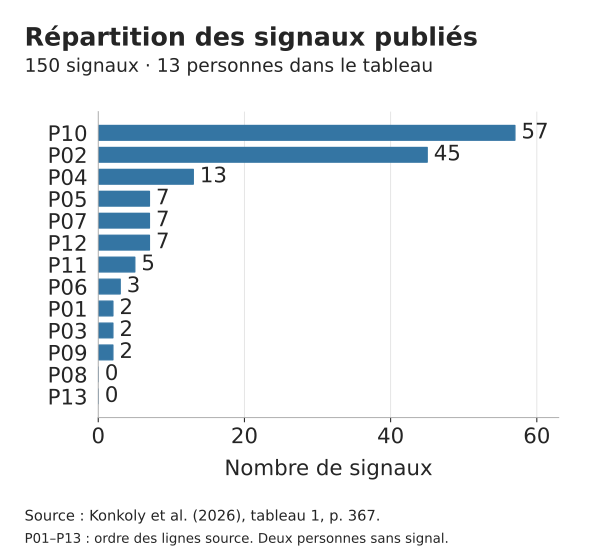
In the table of Konkoly and colleagues (2026), 150 signals come from 11 of the 13 people listed. The two largest contributors provide 102 of them, or 68%. This descriptive recalculation explains why our future contrast will first be computed per person.
The proposed comparison
It requires a bounded interval, then two comparable questions about that interval: a response given during sleep, and a response after awakening, before any feedback on the first response or on the measured duration. A duration recounted for a whole story will not be compared with the duration of a single task.
A discrepancy would indicate that the judgment changed between the two reports. It would not, on its own, determine when that change occurred, nor attribute its whole cause to memory. The act of responding, the change of state and communication difficulties may also play a part.
Detailed analysis
1. What the sources actually allow us to analyze
The search is targeted and makes no claim to be exhaustive. A dataset that was not retrieved is not declared non-existent. The access statements below were checked on October 8, 2026.
| Source or dataset | Contribution and limitation for this question |
|---|---|
| Conduit 2004; Erlacher 2014 | Recall of events or task durations. No individual pair of during/after duration judgements retrieved. |
| Konkoly 2021 and 2026 | Communication during the dream; individual data on request or under restriction. Table of counts accessible in 2026. |
| DREAM / Tononi | Open metadata: 287 awakenings from 39 people. Duration classes after awakening; no judgment during sleep in these tables. |
| Donders 2022 | Repository announcing a publication in preparation; the necessary files are not available in the root examined. |
| DreamViews, 2026 preprint | Forum accounts; no paired physiological recording in the definition of the corpus. |
| MÖBIUS, 2026 | Proposed model of dream/memory confusion; individual clinical data under restrictions. |
The Tononi Serial Awakenings archive was checked by its checksum and the shared keys of its tables. The interval between two awakenings does not give the start of the reported experience. The ordinal classes remain classes; we do not assign them an arbitrary number of seconds.
The Donders repository, the DreamViews corpus and the MÖBIUS model answer other useful questions. Their existence does not fill the missing fields of our comparison. No contact, no new data collection and no EEG reanalysis were carried out in this study.
2. A contrast between reports, with equal weight per person
For an admissible episode, let \(P_{ij}\) denote the estimate during the dream and \(A_{ij}\) the estimate after awakening, expressed in the same unit. The plan proposes:
$$d_{ij}=\log(A_{ij}/P_{ij}),\qquad d_i=\frac{1}{n_i}\sum_j d_{ij},\qquad D=\frac{1}{N}\sum_i d_i.$$The geometric ratio \(e^D\) expresses the mean change of judgment under this weighting. A person who produces many responses does not receive more weight. Uncertainty is estimated by resampling whole people; the episodes of one person stay grouped.
The software keeps every attempt and the reasons for its non-admissibility. It rejects duplicates, impossible chronologies and non-positive durations; it excludes from the main contrast different intervals or questions, unverified signals and responses collected after feedback. An absence of recall stays distinct from a judgment of zero duration.
The plan adopts a report on awakening within two minutes, an operational convention with no biological claim. It provides for a bootstrap of 20,000 repetitions and produces no interval below 10 admissible people. This threshold does not guarantee the quality of the inference. An analysis that removes each person in turn measures how much the result depends on a single participant.
This plan is proposed for a reanalysis of suitable data. It was recorded after reading the papers and before any pairs were acquired in this project; it is not preregistered with an independent registry. The published table, for its part, has undergone an exploratory reanalysis.
3. Why even two reports do not give a speed of consciousness
Consider a purely illustrative measurement model. For a physical duration \(T\), a hypothetical latent factor \(F\) and two report biases \(B_P\) and \(B_A\), we write:
$$P=T F B_P,\qquad A=T F B_A,\qquad \frac{A}{P}=\frac{B_A}{B_P}.$$The calculation builds two scenarios that give exactly the same observations: for 60 physical seconds, a response of 60 seconds during the dream and of 120 seconds afterwards. In the first scenario, \(F=1\), \(B_P=1\), \(B_A=2\). In the second, \(F=2\), \(B_P=1/2\), \(B_A=1\). The observations cannot decide between the two values of \(F\).
This is an algebraic counterexample, with no participant and no validated neural model. It shows the additional assumptions needed before a report can be interpreted as an absolute conscious duration. Controls during wakefulness could study some response biases, without guaranteeing that they stay the same during sleep.
4. Present result and the next evidence needed
The check of the table confirms its totals; the concentration of 68% is descriptive. The formulas and the handling of missing data were tested on artificial cases, with a separate numerical check. The number of human pairs analyzed is 0 and the main effect remains unestimated. This absence of data is not evidence of an absence of change.
The next empirical step requires a dataset documenting both reports of the same interval, the instructions, the timestamps and the attempts without a response. The result will then have to be checked against other people or sessions. A result compatible with zero would not demonstrate the equivalence of the two reports either, without a relevant margin defined in advance.
This study extends the notebook on dreams, time and memory. It specifies a measurement that is feasible in principle and the limits of its interpretation. No result here links felt duration to the gravitational dilation of clocks or to a hypothesis about the origin of the Universe.