Do we age more slowly near a black hole and at the center of the Earth?
Explanation
Yes, in well-defined comparisons, a clock located deeper in a gravitational well accumulates less time. Near the Earth, the gap is tiny. Near the event horizon of a black hole, it can become very large. The two positions and the paths being compared must always be specified.
- Two identical clocks are compared, taking into account how their signals are carried.
- One is placed higher than the other and both are held at fixed positions.
- In the ordinary terrestrial case, the higher clock gradually gets ahead.
A person accompanying each clock would experience their own time normally. Under comparable biological conditions, less proper time means less time available for the body’s processes. This is neither rejuvenation nor a local sensation of slow motion. Biological aging also depends on the environment; the calculations below compare ideal clocks first.
A clock one centimeter above the ground
Compared with an identical clock left at ground level, it gains about 34.4 picoseconds per year: a picosecond is a millionth of a millionth of a second. That is also 94.3 femtoseconds per day. This is not a continuous acceleration of its rate: at a fixed height, the small difference in rate stays practically constant and the lead accumulates.
This number is our calculation for a local gravitational acceleration of 9.81 m/s². The gravitational effect is measured: Bothwell and colleagues, in 2022, resolved frequency differences across a millimeter-scale atomic sample. An optical clock is an atomic clock that uses a transition at an optical frequency; not every ordinary atomic clock reaches this precision.
At the center of the Earth: the zero-force trap
At the center of an ideal spherical Earth, the attractions cancel out: the net gravitational acceleration is zero. Yet the gravitational potential there is lower than at the surface. A central clock therefore accumulates less time. The local force indicates the slope of the potential, not its depth. A valley can have a flat floor while lying far below its rims.
The core is an extended region: the number quoted for the exact center does not apply identically to the whole core. The further down one goes in the stationary spherical model, the more the clock lags behind the surface. The force of gravity, by contrast, does not increase continuously all the way to the center.
The study by Uggerhøj, Mikkelsen and Faye (2016) gives a difference of 2.49 years between center and surface by extrapolating a model of the Earth’s structure over 4.54 billion years. This is a theoretical estimate, not a measurement of two ancient clocks. The same extrapolation amounts to 1.38 second over 80 years. It does not mean that the rocks of the core formed two and a half years after those of the crust.
Near a black hole: a potentially much larger effect
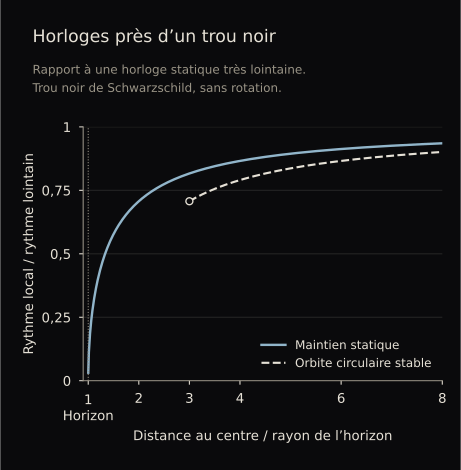
Consider a non-rotating black hole and a clock held at a fixed position outside it. At a distance from the center equal to four thirds of the horizon radius, it counts 30 minutes while a very distant clock counts 60. Locally, these 30 minutes are ordinary. This scenario, however, requires the clock to be held in place by thrust; it is not a stable free orbit.
As the fixed position gets closer to the horizon, the thrust required becomes unbounded in this model. A stationary clock cannot be placed on the horizon. A falling observer follows a different path and can cross the horizon in a finite proper time. The apparent freezing of their last signals for a distant observer does not mean that their personal time stops.
Detailed analysis
What general relativity adds
General relativity, formulated by Einstein in 1915 and set out in his 1916 review paper, relates the geometry of spacetime to its content in energy, momentum and stress. In the form that includes the cosmological constant:
$$G_{\mu\nu}+\Lambda g_{\mu\nu}=\frac{8\pi G}{c^4}T_{\mu\nu}.$$The left-hand side describes the geometry, the right-hand side the physical content that contributes to it. Clocks measure the temporal length of their path in this geometry. Speaking only of a “force that slows everything down” hides this structure.
Weak field and small heights
In a weak, stationary field, at low speeds, with a Newtonian potential Φ equal to zero at infinity:
$$\frac{d\tau}{dt}\simeq1+\frac{\Phi}{c^2}-\frac{v^2}{2c^2}.$$For two clocks held close to each other, a small difference in height Δh gives, to first order, \(\Delta\Phi\simeq g\Delta h\). Hence:
$$\frac{\Delta f}{f}\simeq\frac{g\Delta h}{c^2}.$$For Δh = 0.01 m, this gives 1.09 × 10⁻¹⁸. Multiplied by the seconds in a year of 365.25 days, we recover 34.4 picoseconds. Over one meter, the lead is about 3.44 nanoseconds per year; over one kilometer, 3.44 microseconds per year in the constant-g approximation. Speeds, the Earth’s rotation and variations of the potential require corrections in a precise comparison.
Why the exterior formula does not apply at the center of the Earth
Inside, the matter lying further out than the clock still contributes to the potential, even when its net force cancels by symmetry. One must therefore not extend \(-GM/r\) down to r = 0 by putting the whole mass of the Earth at the center. For a homogeneous sphere of radius R:
$$\Phi(r)=-\frac{GM}{2R}\left(3-\frac{r^2}{R^2}\right),\qquad 0\leq r\leq R.$$ $$\Phi(R)-\Phi(0)=\frac{GM}{2R},\qquad \frac{\tau_{\rm surface}-\tau_{\rm centre}}{\tau_{\rm surface}}\simeq\frac{GM}{2Rc^2}.$$With the Earth’s radius rounded to 6,371 km, our homogeneous calculation gives 1.58 years over the chosen geological time span, or 0.88 second over 80 years. The published result with the PREM density profile, 2.49 years, takes a denser center into account. We quote this result and carry out its time conversion; we did not redo the PREM integration.
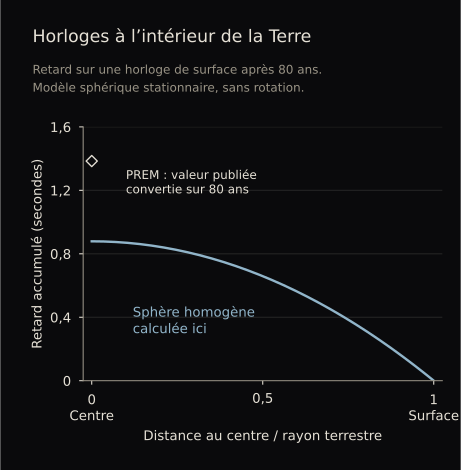
The geological result does not trace the whole accretion, differentiation and evolution of the planet. For an exact history, the potential and the motion would have to be integrated over time. No organism could stay at the center of the Earth: the comparison concerns the proper time of ideal clocks, independently of this physical impossibility.
The Schwarzschild comparison
The horizon radius of a spherical, uncharged, non-rotating black hole is \(r_s=2GM/c^2\). For ten nominal solar masses, our calculation gives 29.53 km. The radius r used here is defined by the area \(4\pi r^2\) of the spheres: its difference from r_s is not directly a radial distance measured with a ruler.
At a fixed position, for \(r>r_s\), the duration compared with the time of a static clock at infinity satisfies:
$$\frac{d\tau}{dt}=\sqrt{1-\frac{r_s}{r}}.$$| Radius from the center | Local minutes |
|---|---|
| 10 r_s | 56.92 |
| 3 r_s | 48.99 |
| 2 r_s | 42.43 |
| 4 r_s / 3 | 30 |
| 1.01 r_s | 5.97 |
These figures are predictions in an ideal model. They are not enough to propose a feasible stay: thrust, tidal forces, surrounding radiation and the round trip must also be considered.
An orbit is not being held static
For a circular geodesic orbit in the same spacetime:
$$\frac{d\tau}{dt}=\sqrt{1-\frac{3r_s}{2r}}.$$Stable circular orbits begin at \(r=3r_s\), with marginal stability at that limit. The ratio is then 0.707, instead of about 0.816 for a static clock at the same radius. Orbital motion therefore really contributes to the difference. Rotating black holes require a different geometry and a specification of the direction of the orbit.
What is tested, and what remains extrapolated
Optical clocks directly test rate differences in the Earth’s field. Near the Galactic Center, GRAVITY observed in the light of the star S2 a signal combining gravitational redshift and transverse Doppler shift, consistent with general relativity. This is neither an isolated measurement of the gravitational component nor an observation at the horizon.
The GW150914 detection tests another prediction: the gravitational waves from a black hole merger. These successes do not give us access to the interior singularity. The distinction is developed in the study on Hawking and the limits of theories.