BCI: a decoder facing a new person
Explanation
We processed 540 EEG trials from 12 people to ask a precise question: does a decoder trained on some brains work on a person it has never seen? The recordings come from existing open data. The participants had to imagine a movement of the left hand or the right hand, following a visual cue.
Our simple model reaches 55.3% when it learns from other recordings of the same person, and 51.8% when the person tested is entirely absent from training. The measure gives the same weight to both classes; always answering “left” scores 50%. The first result indicates a weak association in this exploratory setting. The second is not enough to establish decoding beyond our label-shuffling control.
This result concerns an elementary method and a small subset. It sets no limit on BCIs. It shows why “the software recognizes a task” and “the software works for a new user” must be checked separately. We also publish the individual scores, so that the mean does not hide the differences.
Recent implanted interfaces achieve other capabilities, notably for communication. Below we examine four studies from 2026, then our own analysis. The tasks, the sensors and the populations differ: their percentages cannot be compared directly with those of our EEG.
Detailed analysis
1. Four recent results, four concrete difficulties
Using a BCI at home. Card et al., June 2026, document more than 3,800 hours with one implanted person, with an average of 56 words per minute in personal use. The 99.2% word accuracy concerns a copy task; in personal use, 53.3% of sentences are judged entirely correct straight away. The units differ. Setup remains assisted and the system recalibrates in the background.
Speaking and gesturing at the same time. Brosler et al., September 2026, study isolated movements in 3 people, and simultaneous data in 2. The simultaneous copy quantified in real time concerns one person. Training on several contexts helps limit unwanted activations of one modality when only the other is intended. The conversation demonstrations remain limited; they do not validate general free interaction.
Measuring a perceptual benefit. Choudhari et al., May 2026, decode auditory attention to enhance one voice among competing voices. They then evaluate comprehension and preference. The 4 participants are recorded with intracranial electrodes during an epilepsy workup and report normal hearing. This result therefore does not validate a consumer EEG device intended for hearing loss.
Transferring between people. Spalding et al., July 2026, align signals of actually produced speech in 8 people. The alignment uses training data from the target patient, keeping that patient’s test data apart. “Between people” therefore does not mean “without calibration”. Transfer to a paralyzed person remains a separate question.
These studies guide our research question: measuring what remains valid when conditions change. We have to examine the data needed to get started, the adaptations during use, unwanted activations and the functional benefit. A score obtained in a guided task does not answer all these questions.
2. The signals we actually analyzed
We downloaded 36 EDF files from the PhysioNet EEG Motor Movement/Imagery dataset, attributed to Gerwin Schalk and the BCI2000 contributors, under the Open Data Commons Attribution License 1.0. The subset comprises identifiers S001 to S012 and recordings 04, 08 and 12. These recordings correspond to left-hand/right-hand imagery, as the MNE documentation also states.
The annotations give 274 “left” trials and 266 “right” trials. No trial of these two classes was excluded on the basis of its amplitude or its result. The rest periods are outside the chosen task. The subset and the parameters were written down before the first computation of scores, with no external preregistration and no selection based on performance.
The URLs, sizes and SHA-256 hashes of the raw files are kept. The derived features, labels, predictions and protocol are versioned. This is a reanalysis of existing measurements, with no new human data collection by Aeternam.
3. A deliberately simple model, two ways of splitting the data
Each trial provides a three-second window, from 0.5 to 3.5 seconds after the cue. We use three electrodes, C3, Cz and C4, and two frequency bands: from 8 to under 13 Hz, then from 13 to under 30 Hz. This gives 6 features, the logarithms of the powers per channel and per band. The computation removes the segment mean, applies a Hann window and integrates the one-sided periodogram. The recorded reference is kept.
The classifier is a linear discriminant analysis, with equal prior probabilities and regularization fixed at 0.1 toward an identity matrix of the same trace. Standardization and the model are fitted on the training data only. No parameter is optimized on the results presented.
- Entire person held out, main evaluation. Train on eleven people and predict the trials of the twelfth, then repeat for each person. No signal from the person tested is used to fit their decoder.
- Recording held out, secondary evaluation. For each person, train on two of their recordings and predict the third, then rotate the roles. Here the model already knows data from this person.
A recording, or run, is a block of tasks in the dataset. Holding one out is not the same as testing another day. The two training runs may come before or after it: this is not a prospective validation after calibration. The two evaluations also change the amount and the origin of the training data. Their difference is not a causal estimate of the effect of calibration.
There are 12 training/test splits for the first evaluation, and 36 for the second. In each, every trial is predicted exactly once outside training. We compute the balanced accuracy on each person’s predictions, then the mean across people. No window from a given trial ends up on both sides.
4. Results and controls
| Data held out for testing | Mean balanced accuracy | Permutation p, Holm-corrected |
|---|---|---|
| Entire person | 51.8% | 0.149 |
| Run, same person | 55.3% | 0.020 |
Balanced accuracy is the mean of the rate of correct answers in each class. Its constant baseline is 50%, even if the left/right counts differ. Between people, the observed scores range from 40.8 to 68.3%. For held-out runs, they range from 40.8 to 75.6%. These ranges describe our sample, not the uncertainty in the population.
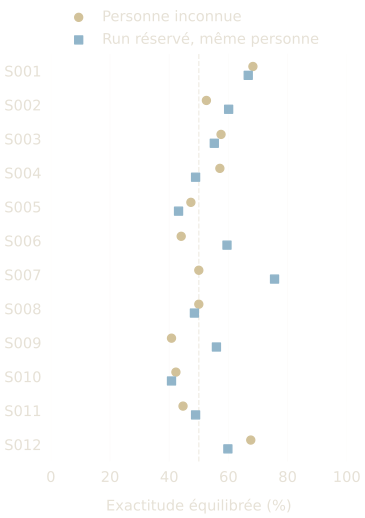
Read each person’s scores
| Person | Whole person held out | Run held out, same person |
|---|---|---|
| S001 | 68.3% | 66.7% |
| S002 | 52.6% | 60.1% |
| S003 | 57.5% | 55.2% |
| S004 | 57.1% | 48.9% |
| S005 | 47.3% | 43.2% |
| S006 | 44.0% | 59.5% |
| S007 | 50.0% | 75.6% |
| S008 | 50.0% | 48.5% |
| S009 | 40.8% | 56.0% |
| S010 | 42.3% | 40.8% |
| S011 | 44.7% | 48.9% |
| S012 | 67.6% | 59.8% |
The control shuffles the left/right labels within each person/run block, then fully retrains both evaluations. We ran 200 permutations, with a fixed seed. The test is one-sided: count the shuffled scores at least as high as the observed score, adding one to the numerator and to the denominator. Holm’s method corrects the two tests.
The result on an unknown person does not allow us to conclude that decoding is established beyond this control. This does not prove the absence of information. The result on a held-out run indicates a weak association, under the assumptions of the test. A p-value is neither the probability that the model is true nor the probability that a particular prediction is correct. The limited number of permutations makes their estimate coarse.
We checked the spectral computation for one trial against SciPy, then the predictions of both evaluations against an independent implementation of discriminant analysis in scikit-learn, with the same choices of standardization, covariance and priors. No prediction differs. This check verifies the computations; it is not enough to validate the biological interpretation.
5. What this analysis leaves open
The cue is not a pure measure of intention. The classes are associated with a visual presentation. Sensory responses, residual movements or other artifacts may contribute to the signal. The central channels and the post-cue window are not enough to rule them out. A successful classification would therefore not, on its own, demonstrate the reading of an isolated motor intention.
The permutations assume that the trials are exchangeable within each block. A temporal dependence could weaken this assumption. The models of the different folds also share training data: we do not treat these folds as independent experiments, and we do not construct a binomial interval over the full set of predictions.
The dataset is small and chosen for convenience, and the model uses only three channels and six powers. It evaluates neither a high-performing, carefully tuned architecture nor all the available participants. This analysis does not reproduce a published MOABB result and does not claim a new decoding method.
Finally, we use a full three-second window in a guided task. We measured neither real-time control, nor throughput in free use, nor false commands during rest. Nor do these data answer the questions of intervention on vision or intervention on memory.
6. The next useful contribution
We have now run a Monte Carlo simulation of calibration and noise, fitted to the EEG features of this study. It explores the effect of the number of personal trials in an explicit model. Comparison on new, held-out human measurements remains a separate step: our simple model could serve as a baseline against spatial filters or covariance models, with tuning kept entirely separate from the test.
A second question would concern adaptation: how many trials from a new person are needed to improve their score? Calibration and evaluation would have to be separated chronologically, with a comparable amount of training data. A true cross-day study would require a dataset that documents those days. To move toward free use, rest would also have to be included and commands triggered without intention counted.
The work done here provides a verifiable starting point: signals actually processed, explicit splits and a modest result kept as it is. The next comparisons will have to maintain this separation between choosing the method and evaluating it.